How digital signage is transforming timetable management in educational institutions?
What is digital signage in schools/universities?
Digital signage refers to using screens to display real-time timetables and schedules across educational institutions. This modern solution replaces traditional paper boards and allows clearer, more responsive communication of information such as:
Classroom names
Course schedules
Instructors responsible for each session
The challenges of traditional paper-based timetables
Managing and sharing timetables is a major challenge for modern schools. Paper noticeboards have many drawbacks in a dynamic educational environment: information becomes quickly outdated, last-minute changes are hard to communicate, and staff spend a lot of time keeping boards up to date.
Digital signage for schools: solutions and benefits
1. Real-time updates and wayfinding
A key advantage of digital displays is that they show up-to-date information instantly. When a class is moved, canceled, or relocated, the update appears immediately on all relevant screens, avoiding misunderstandings and unnecessary trips.
Two main display formats are available to meet different needs:
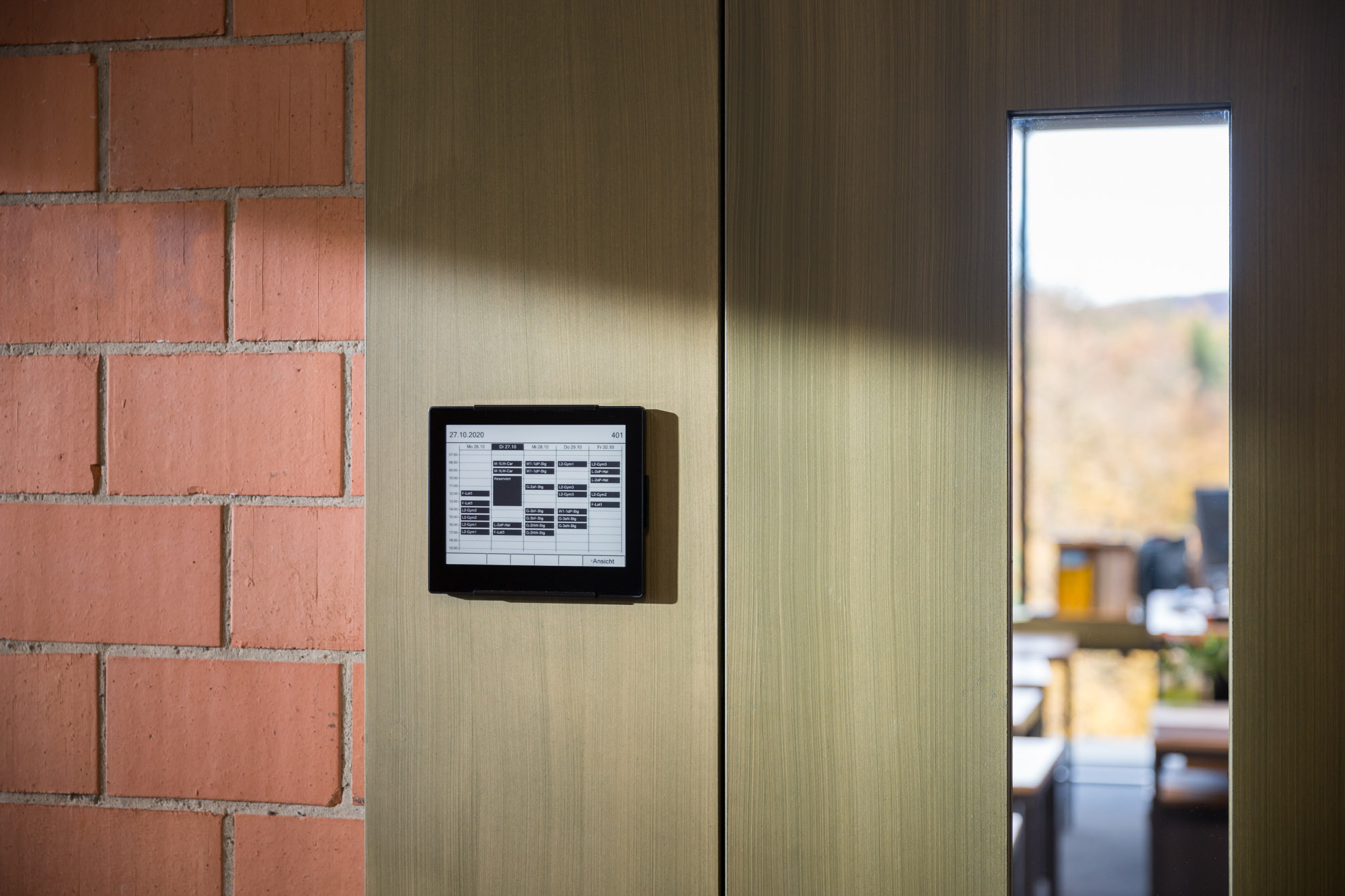
Classroom entrance scheduling display:
Placing a ROOMZ Room Scheduling Display at the entrance of each classroom improves the daily experience and ensures information accuracy.
Displayed information:
Room name
Ongoing and upcoming classes
Course/instructor details
Daily or weekly view
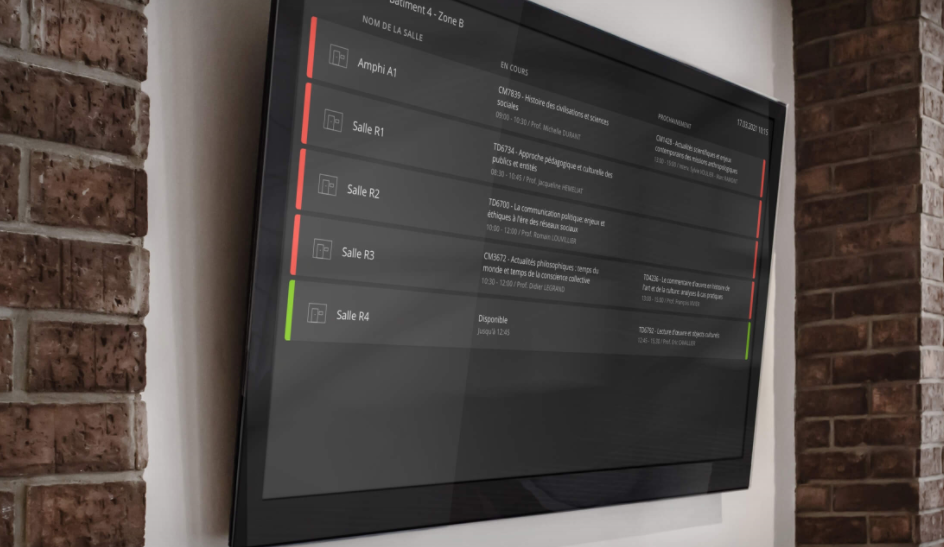
Centralized Flightboard display:
In high-traffic areas such as entrance halls or main corridors, flightboard-style displays provide a large-format overview.
Displayed information:
Current classes
Upcoming sessions
Room/course/instructor details
Building or floor overview
2. Long-term cost savings, sustainability, and environmental impact
By choosing long-lasting and wireless equipment, schools make a long-term investment that is both cost-efficient and easy to maintain. E-ink displays consume very little energy and require no complex cabling, reducing installation and maintenance costs.
Moving away from paper timetables also supports sustainability goals. There is no longer any need to print, laminate, or replace paper schedules. This change reduces the institution’s carbon footprint while generating substantial savings.
3. Optimizing classroom use
Schools often face a shortage of available study spaces. Digital timetables provide a practical solution by showing which rooms are free and for how long. Students can quickly identify and use available spaces for study or group work.
Leading institutions using ROOMZ education displays
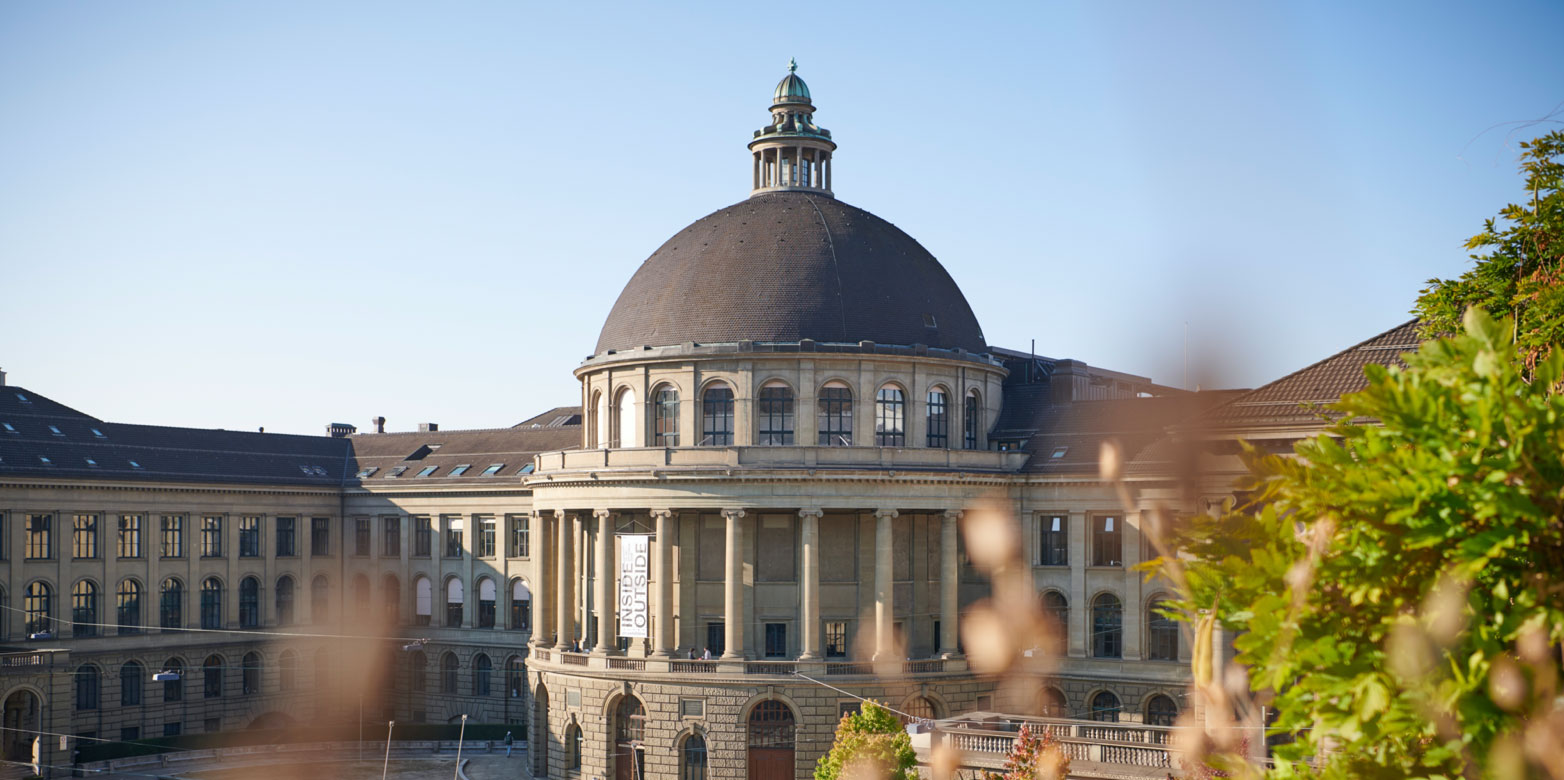
Since 2016, the Swiss Federal Institute of Technology Zurich (ETH) has relied on ROOMZ displays to manage timetables and space reservations. With 800 screens now in daily use, this world-class institution demonstrates the robustness and reliability of the solution in a demanding academic environment.
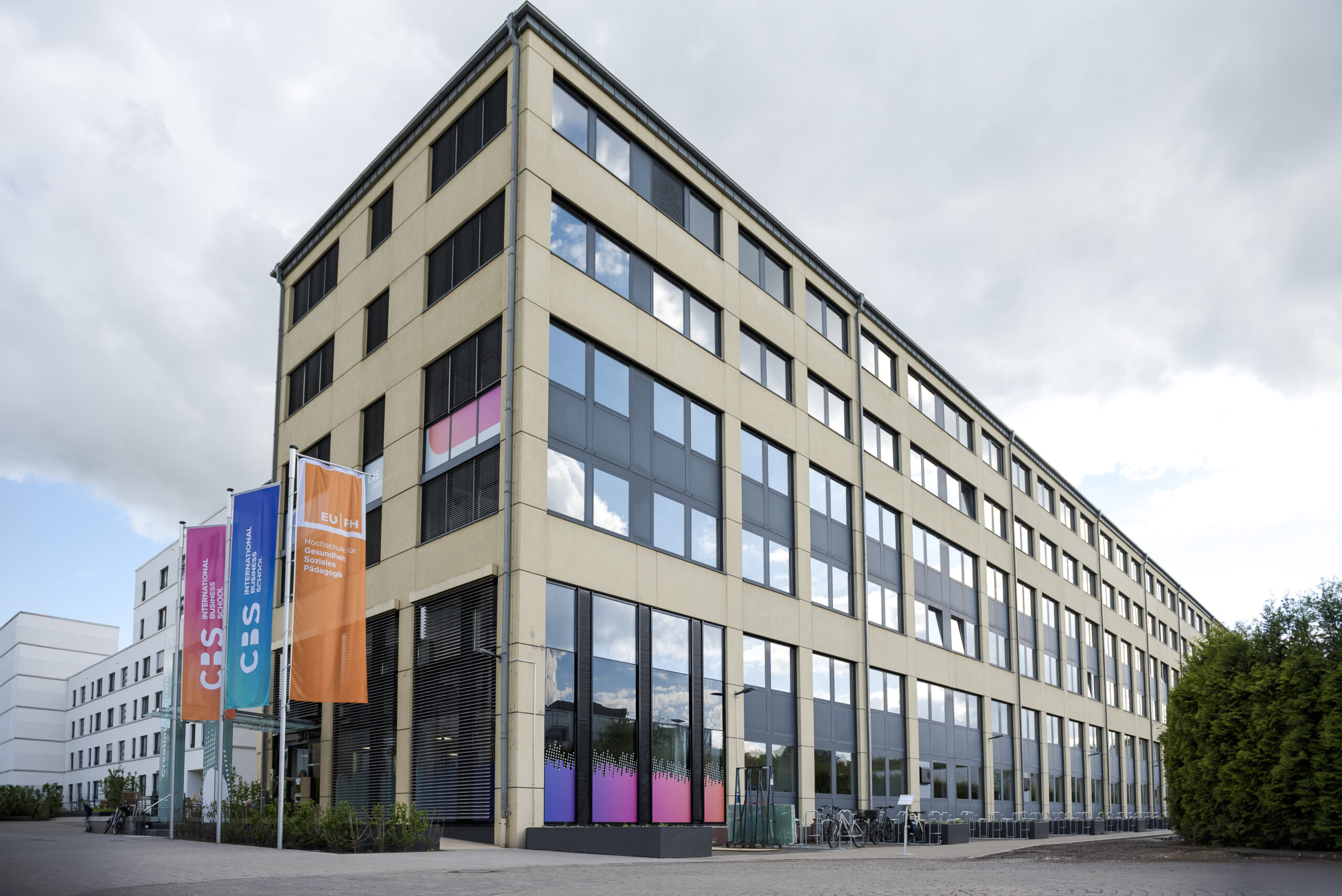
Other prestigious schools in Europe have also adopted digital signage. At CBS International Business School in Germany, staff report that “the search for the right classroom, which was sometimes very difficult, has finally come to an end” thanks to digitalization.¹
Even historic institutions are embracing this transformation while preserving their architectural heritage. ROOMZ wireless solutions require no invasive installation, making them a perfect fit for listed or protected buildings.
The University of Basel, for example, adopted ROOMZ after a successful pilot phase. As one faculty member noted: “Auditorium support circulates around the building during the day, using the door signs as orientation. This up-to-dateness of the information is a huge added value compared to the paper timetables.²”
Digitizing timetable scheduling is more than a technological upgrade: it is a real lever for improving the educational experience. By removing the limits of paper, keeping information always up to date, and optimizing communication flows, this approach significantly enhances operational efficiency in schools and universities.
What will be the major issues for facility management for schools and universities in 2025?
School facilities management involves overseeing and maintaining all school-owned buildings and assets, including tasks that repair, maintain, and improve the infrastructure to ensure a safe, efficient, and effective learning environment.
The job of facility manager has been undergoing a major transformation for several years now. Facility managers must respond to growing challenges brought on by technological developments and new student expectations. This article provides an overview of the most important issues for 2025:
Integration of the IoT and artificial intelligence in schools and universities
The digital transformation in higher education now includes the integration of advanced technologies, such as the Internet of Things (IoT) and artificial intelligence (AI), which are essential tools for optimizing infrastructure management. IoT makes it possible to set up intelligent systems that monitor building occupancy and energy efficiency in real time.
This enables institutions to better manage their resources and to avoid the waste resulting from underutilized spaces or equipment. With ever growing numbers of students, efficient space management becomes an important advantage in making campuses ready for the future and improving overall efficiency.
Sustainability and energy efficiency of school buildings
Higher education institutions must respond to environmental challenges by adopting sustainable practices. It is essential to implement strategies to reduce their carbon footprint, such as the use of renewable energy sources and improving the energy efficiency of buildings. A greener and more energy-efficient approach will be a key factor for the success of school campuses in 2025.
Governments are increasingly implementing energy-savings plans to meet this challenge, including the renovation of university buildings with a range of IT equipment to promote the circular economy. France is a good example of this, with its implementation of the Campus Energy Efficiency Plan (PEEC2030), intended to reduce energy consumption at universities by 30% by 2030, with the ultimate aim of meeting the goal of carbon neutrality by 2050[1].
In this dynamic environment, some universities are already taking exemplary initiatives. ETH Zurich, for example, has been using energy-efficient ROOMZ screens in its classrooms since 2016. With 800 screens installed to date, the university is demonstrating its outstanding energy efficiency: an average battery life of more than four years per display and an extremely low failure rate of around 1.6% per display and year.
Adapting to new learning methods
Hybrid working and distance learning are now also commonplace in higher education. Facility managers need to redesign spaces to integrate flexible technologies and to support diverse learning environments. Classrooms and workspaces need to be reconfigured to facilitate remote collaboration, while maintaining areas for traditional teaching.
The smooth management of schedule updates is facilitated by installing dynamic and up-to-date signage, such as ROOMZ Displays, to display class schedules at the entrance to rooms or by placing the ROOMZ Flightboard in corridors to help students find their way.
This approach is exemplified by the case study of CBS International Business School in Cologne, Germany, which has equipped its buildings with more than 100 ROOMZ Displays, thereby ensuring error-free information sharing in real time.
Digitization of spaces: How the education sector is adapting to new needs
The digitization of educational spaces refers to the integration of digital technologies to transform traditional learning environments into connected, interactive spaces. Educational institutions are adapting through:
Hybrid learning models combining physical and virtual spaces
Cloud-based learning platforms and digital resource management
Data-driven personalized learning environments
Remote collaboration tools and virtual classrooms
This transformation addresses evolving student needs for flexible, technology-enhanced learning experiences while preparing institutions for future educational challenges.
The new needs of “digital native” students
A turnaround is in progress in the higher education landscape, with more and more digital resources being integrated into working and educational methods to meet the needs of the digital native students of today. The connection between the digitisation of education and user involvement is clear. Providing a better educational experience allows students and faculty to feel part of a community and helps develop a stronger sense of belonging. In a highly competitive industry where students are spoilt for choice and make their decision for or against an educational institution partly in terms of what experience the institution can offer them, the digitisation of teaching spaces and resources is proving to be one of the keys to attracting and retaining new talent.
Two complementary areas of development are involved in this digitisation: the transformation of rooms and the choice of teaching tools offered to students. The physical organisation of educational institutions is changing. The image of a classroom with desks lined up facing the teacher standing at the blackboard seems outdated. Today’s classrooms are flexible, the furniture can be moved (e.g. removable tables) to suit the type of activity. These physical transformations are intended to promote exchange between students and to encourage working together. To support this change and increase student commitment, technological tools, on the other hand, are encouraging new educational methods. More collaborative, interactive digital platforms with their diverse content facilitate learning in which the user is active rather than passive.
The next campus generation will be smart
While the term “Smart Campus” is not new, its development has accelerated in recent years, as it has in other areas of activity that now serve as examples of the digital transformation of the education system.
“The technological innovations used in banking, sales, or employment can be extended to the higher education sector. Institutions must take a sustained and relevant approach to equipping themselves with technologies and analytics tools that enable them to improve the daily lives of users.”1
By attempting to combine environmental innovation and digitisation, the Smart Campus concept aims to simultaneously influence six complementary areas: security, mobility, administration, campus life, ecology and education. Implementing a Smart Campus project therefore goes beyond a simple technological transition, it also involves addressing climate and ecological issues by introducing more intelligent buildings.
“The connected campus is characterised by devices that communicate with each other and with human sensors. They are integrated into the Smart Campus to provide specific services, such as access control, display systems, room management, or lighting management.”2
The benefits of building a Smarter Campus extend to more than just the users. Institutions can achieve real savings by controlling their operating costs and energy consumption through the use of networked technologies.
Digitisation of spaces to improve the quality of life on campus
Universities have been faced with a recurring problem for many years: the lack of space in their facilities.
“University libraries offer on average one seat for every 12 students.”3
Lower than it should be, this number contributes to frustrations and logistical problems within universities. Faced with this challenge, one of the solutions is to “smooth the flow” of students coming and going. Some digital tools already exist towards this end to help users better plan their schedules by identifying available spaces within institutions. For example, mobile applications have been developed that allow students to find out in real time how many seats are still available in university libraries. Issues relating to room management and lack of space are what specifically led ETH Zurich to turn to ROOMZ to optimize the use of its classrooms.
“Space is precious and our students have too little of it to study and work. The idea was born to make our 600 meeting, conference and seminar rooms available for learning when they are not otherwise in use.”
– Rectorate ETH Zurich
Thanks to the implementation of ROOMZ Displays at room entrances, students can see at a glance if the room is reserved, can use it to study if it is not, and know when the next class will take place.
At the same time, ETH Zurich expanded its premises by moving into a new building, the “Octavo” in Oerlikon, last November. Strategically located between the “Hönggerberg” and “Zentrum” campuses, the Octavo promises a double added value: it will compensate for the lack of space and promote exchange between employees through innovative methods of collaboration.
The layout of the space has been designed to create hybrid collaboration spaces that can be adapted as needed to encourage this. The new building offers places to spend time and interact (shared offices, meeting rooms, small collaboration spaces), but also quieter spaces suitable for individual work (huddle spaces and closed offices). These flexible and modern offices are primarily for faculty and researchers and have been designed to promote interdisciplinary exchange between staff, while fostering cohesion.
“We have all become familiar with new ways of working and different forms of collaboration over the past few months. I look forward to exploring these further with the people at ETH and implementing them in our daily work.”4
In the medium term, ETH plans to integrate ROOMZ technology into these new collaborative spaces by digitizing plans of the building on its intranet in order to display the occupancy status of huddle spaces and offices on digital screens, smoothing the coming and going of users.
Often located in older buildings, sometimes even classified as historic, some schools and universities are taking advantage of renovation projects to digitalise their spaces. During a recent renovation, this was notably the case for the Kantonsschule Olten, which decided to replace its old paper scheduling system, located at the entrance to each classroom, with ROOMZ Displays. This modernisation has greatly assisted the daily lives of staff and students, as Isabelle Berger, head of IT services at the school, points out: ” Our system was really out of date and quite inflexible. Each semester, someone had to take down the old schedules from all 100 classrooms and replace them with the new ones. As soon as a change occurred, the schedules were no longer up to date.”
This was also the case at the University of Basel, Switzerland’s oldest university, which was founded in 1460. Currently in the midst of renovating its audio and video infrastructure, the institution wanted to provide its users with modern digital signage that was updated in real time. The project managers turned to the ROOMZ solution after discovering it while visiting the ETH Zurich University. Since its introduction, the solution has been convincing and is now helping to facilitate the flow of people to and from the campus:
“Auditorium support circulates around the building during the day, using the door signs as orientation. This up-to-dateness of the information is a huge added value compared to the paper timetables.”
– Michèle Martin, in charge of the teaching rooms in the Kollegienhaus.
The digitisation of educational institutions presents a double challenge: On the one hand, it is a question of offering students and teaching staff the best possible educational path by integrating different forms of learning through innovative platforms, while on the other hand, it is about improving the user experience by acting within the infrastructure itself to offer a more hybrid use of spaces and thus optimize their occupancy.