Why choose an e-ink meeting room booking display for your workplace?
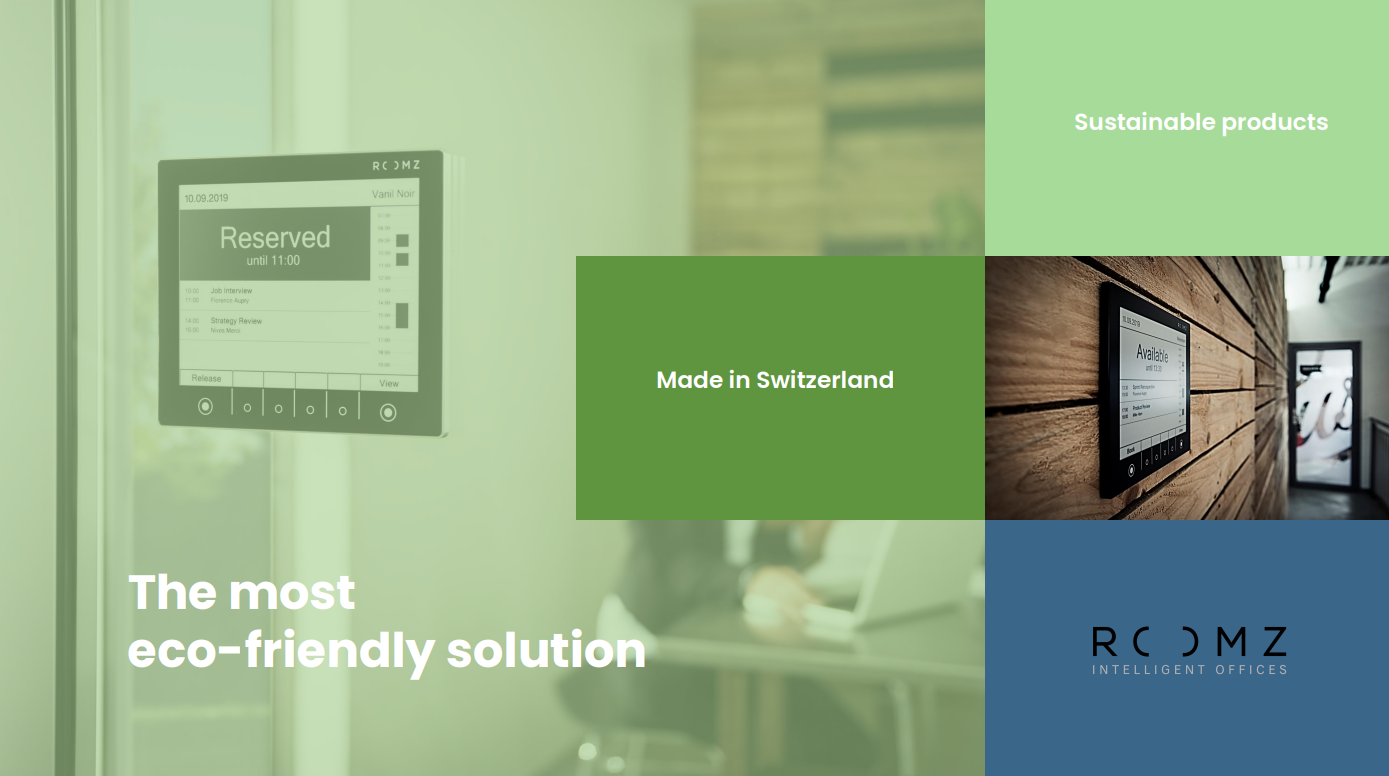
E-ink technology has become a discreet yet highly effective solution for modern workplaces. Originally developed for e-readers, it now stands as a powerful alternative to traditional digital signage in professional environments. At ROOMZ, this technology powers our meeting room booking displays, offering a simple, energy-efficient, and elegant way to manage meeting spaces. .
Ultra-low energy consumption for efficient workplaces
E-ink displays stand out for their extremely low power use. Unlike traditional screens, they run on battery power and only consume energy when the content changes, making them remarkably efficient. In an office environment, this is ideal since meeting room information does not need constant updates throughout the day.
Taking the ROOMZ meeting room booking display as an example, this technology is pushed to its full potential: our displays consume up to 10,000 times less energy than a traditional wired screen. Thanks to this energy efficiency, the displays offer up to five years of battery life before replacement, while remaining connected and easy to manage remotely.
Updates are performed remotely, ensuring content is always current without any on-site maintenance. This significantly reduces both operational costs and technical complexity.
Clear, paper-like digital signage in every workspace
With high contrast and a 180-degree viewing angle, e-ink displays deliver outstanding readability under any lighting conditions. Unlike backlit screens, they do not emit light but reflect ambient light, similar to paper.
The result: no glare, no visual strain, and perfect readability even in direct sunlight or under bright office lighting. This improves user comfort and ensures information remains visible all day long.
E-paper technology also maintains image quality over time, with sharp contrast and stable performance even after years of use. .
A reliable display with a long lifespan
E-ink displays generate no heat, reducing wear on components and preventing overheating or electrical stress. They require no fans, no complex maintenance, and no wired installation.
This makes them an ideal choice for organizations seeking reliable, low-maintenance, and energy-saving digital signage. Combined with wireless connectivity, ROOMZ displays can be installed anywhere in the workplace—without cables or proximity to a power source. .
.
E-ink displays provide a robust, reliable, and sustainable way to manage meeting rooms. They combine energy efficiency, flexibility, and visual clarity while supporting greener office operations. ROOMZ displays go beyond digital signage—they simplify meeting room management and help shape connected, agile, and responsible workspaces.
Meeting room booking system: why choosing a sustainable, maintenance-free solution makes a real difference
Choosing durable, maintenance-free hardware for your meeting room booking system helps:
Optimize operational costs
Reduce technical constraints
Deliver a smooth experience to employees
When selecting a door signage solution, wired panels may at first appear more powerful. At ROOMZ, we believe the opposite is true. What really matters is often overlooked: the durability and simplicity of the hardware.
In many workplace projects, cabled booking displays can quickly show their limits:
Common issues include overheating touchscreen panels
Complex cabling installations
Frequent software updates
High energy consumption
What is supposed to streamline workspace management may ultimately create operational and budgetary challenges.
.
1. The tangible benefits of low-power IT equipment
Cost optimization through long-lasting technology: Fewer replacements and less technical intervention mean long-term savings. Durable hardware, such as electronic ink (e-ink) displays, offers a significantly longer lifespan compared to traditional booking tablets.
For Facility Managers, this translates into better budget predictability and the ability to allocate resources to other strategic priorities.
A smooth experience for users: Autonomous systems guarantee smooth usage without downtime. Employees benefit from a frictionless booking experience, while IT Managers face fewer support requests and ongoing maintenance tasks.
A strong environmental commitment: Beyond cost considerations, investing in sustainable equipment supports broader ESG initiatives. By reducing the frequency of hardware replacement, companies limit electronic waste and significantly lower the carbon footprint of their office spaces.
.
2. IT security: the risks of embedded meeting room booking systems
Many meeting room booking solutions on the market operate like small computers, running embedded operating systems such as Android or Linux. While these platforms offer advanced capabilities, they also come with two major risk factors that must be considered:
Ongoing update management: Each connected device requires regular software patches and updates. Multiplied across dozens or even hundreds of displays, this could become a significant workload for IT teams.
Potential vulnerabilities: Embedded systems often store temporarily data such as calendar entries, meeting room names, or user email addresses. Each connected endpoint can become a potential entry point for cyberattacks, especially in highly regulated industries.
Choosing a booking display that runs without an operating system helps reduce security risks at the source and protects sensitive company data.
.
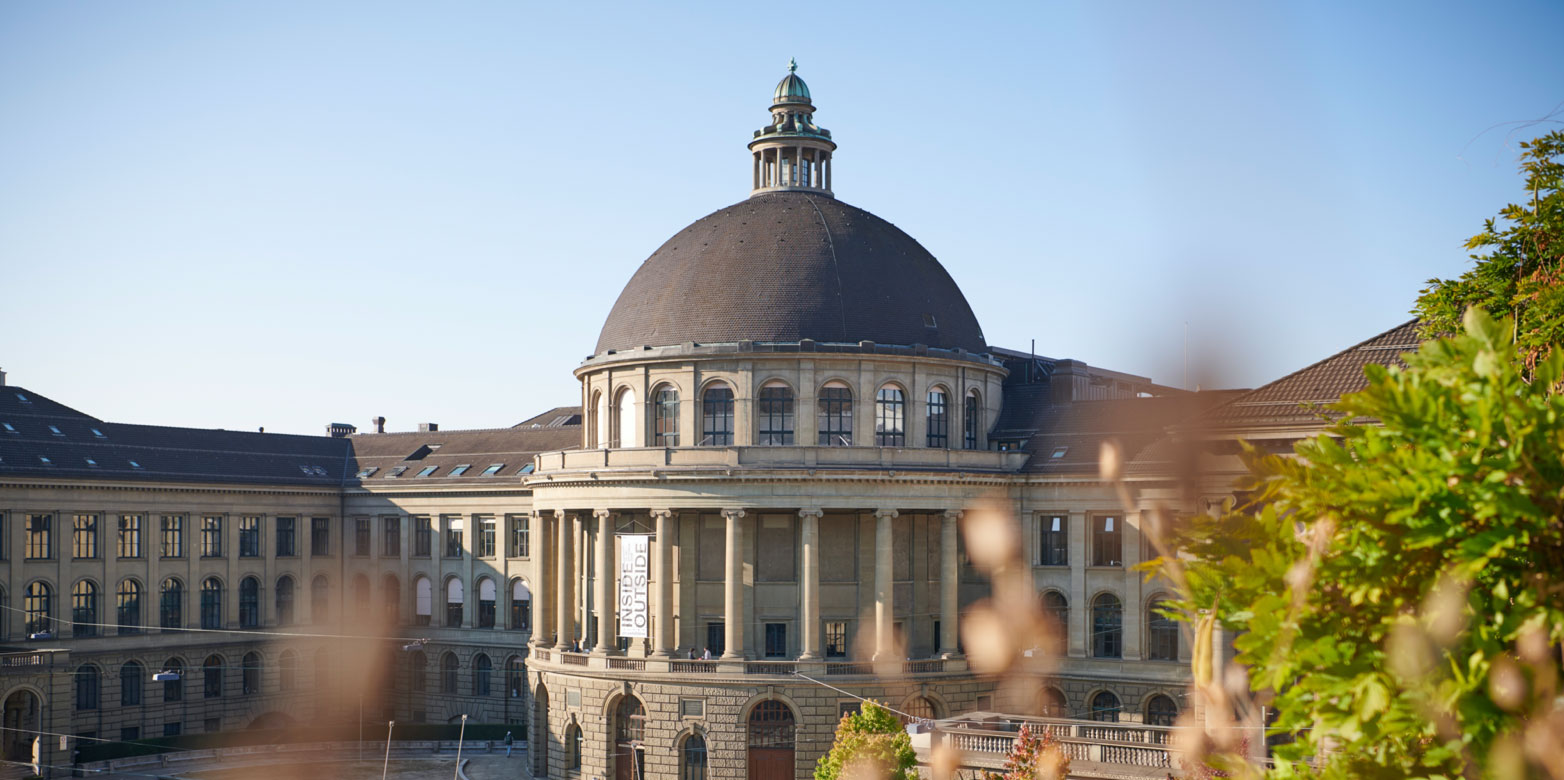
3. ROOMZ, a smart meeting room booking system trusted by ETH Zurich for long-term reliability
At ROOMZ, durability and simplicity are at the core of our approach:
Our displays operate without an operating system.
They are fully autonomous and wireless
They require no preventive maintenance
ROOMZ displays consume up to 10,000 times less energy than a wired booking tablet
They offer up to 4 years of battery life and a lifespan of 10 to 20 years
All while delivering a reliable user experience.
How is such low energy consumption possible?
ROOMZ displays only connect to the server when they need to update meeting room booking information
They remain in sleep mode 99% of the time
They don’t run any energy-intensive systems
Our very first customer, ETH Zurich, perfectly illustrates the long-term durability of ROOMZ solutions:
“After 7 years of operation, the displays show almost no visible degradation, and we can expect them to last for another 10 years.”
Optimizing office space to reduce carbon footprint: A data-driven approach
Workspace analysis is proving to be a high-impact lever in the effort to reduce the carbon footprint of office operations. By identifying underused areas, regrouping teams and adjusting spatial layouts, companies can directly reduce energy requirements related to heating, lighting and ventilation.
In a context where corporate sustainability has become a strategic imperative, organizations are increasingly turning to space utilization data as a foundation for energy optimization and carbon reduction initiatives.
1. Identify high and low-usage workspace areas
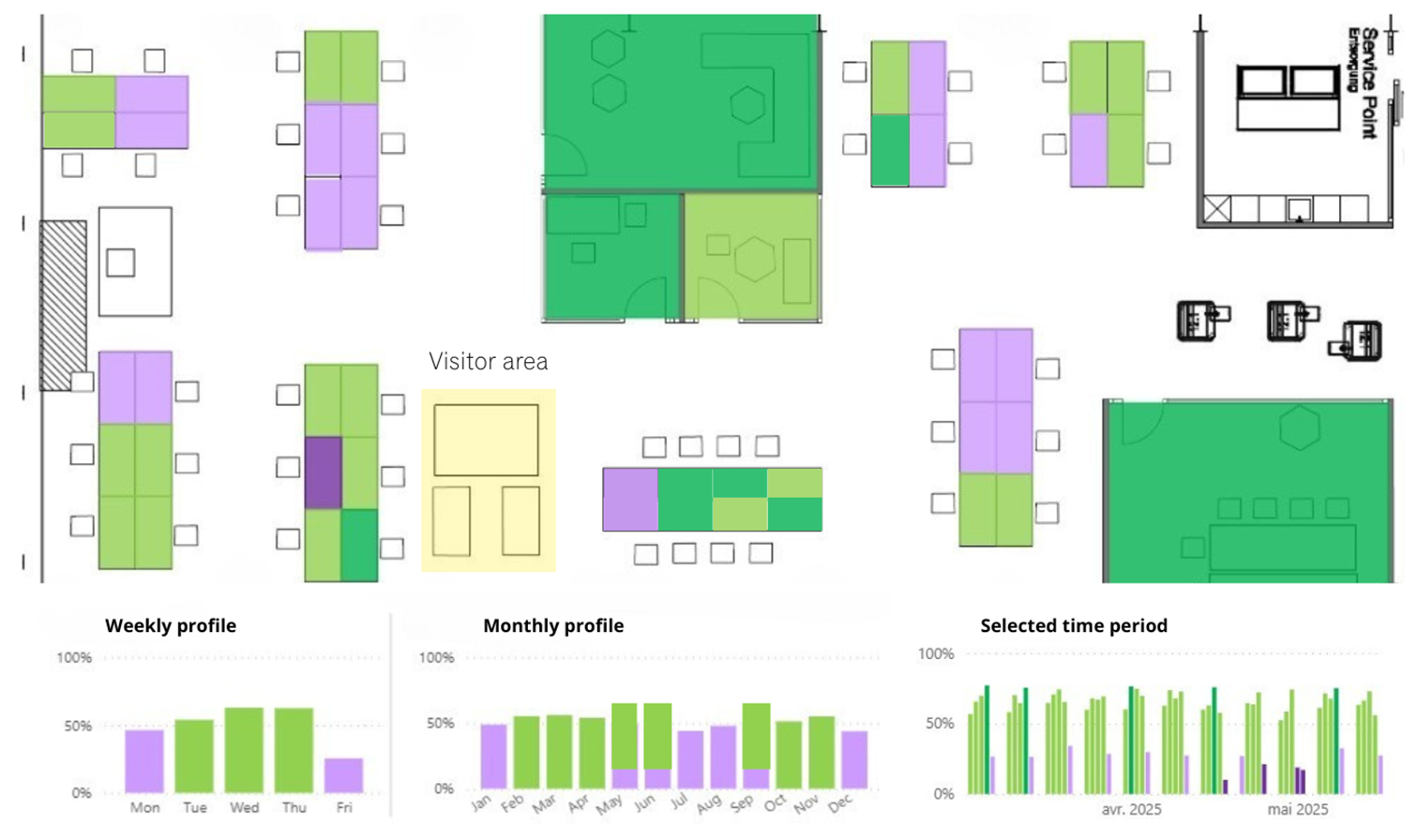
Occupancy analytics provide a detailed understanding of which areas are overutilized and which remain consistently underused. Interactive floor plans offer real-time visibility into workspace usage, enabling facility teams to make operational decisions based on actual occupancy patterns.
By adjusting which zones are open or adapting space types based on actual activity levels, organizations can optimize workspace usage and significantly reduce energy consumption across their office environments.
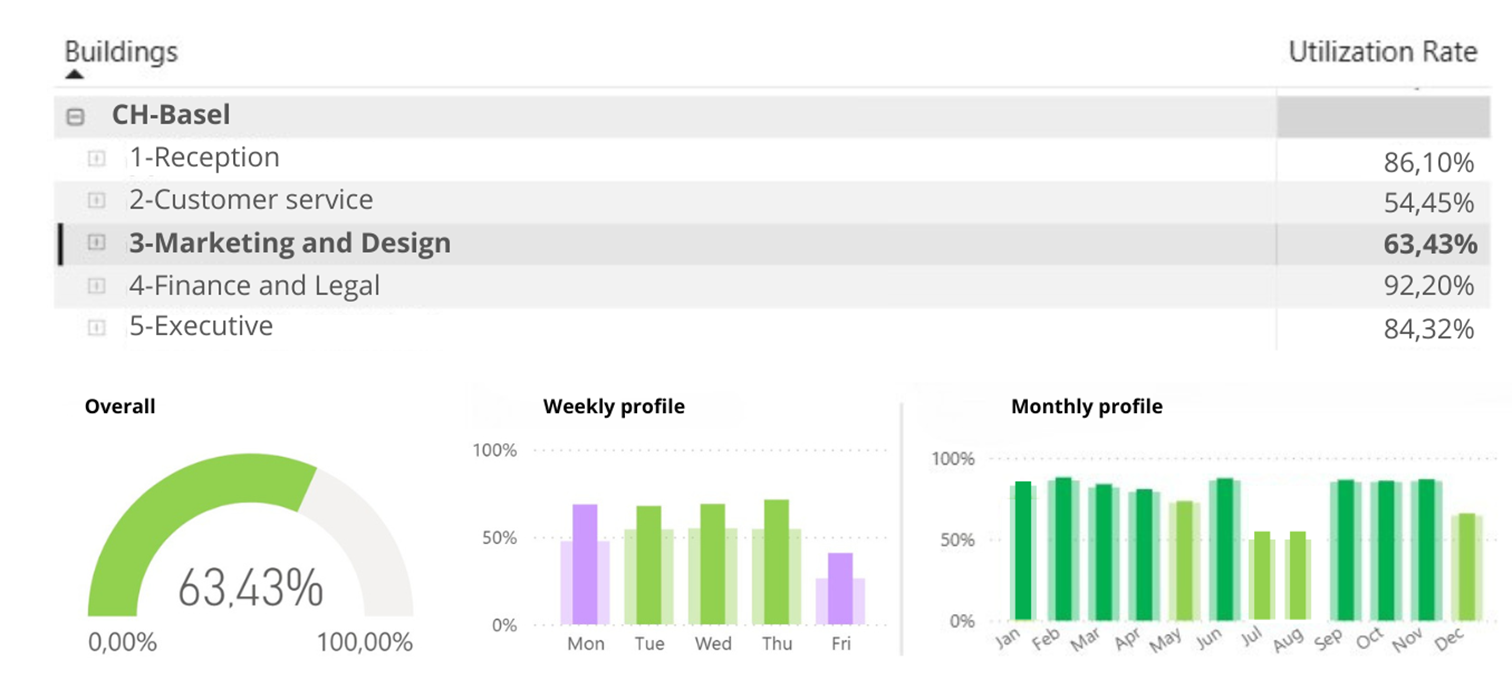
Analyzing occupancy by building, floor or time period helps identify underexploited areas and informs strategies for regrouping teams into higher-efficiency zones. This approach supports footprint reduction and overall energy efficiency.
For instance, if floors 2 and 3 show low attendance on Fridays, consolidating all staff on a single floor could justify powering down HVAC and lighting systems in unused areas, delivering immediate energy savings with no operational impact.
3. Fine-tune energy management with ROOMZ Advanced Analytics and tagging
ROOMZ Advanced Analytics equips organizations with a precise, customizable framework for aligning workspace usage with sustainability objectives. Through a flexible tagging system, workplace managers can segment and analyze workspaces based on multiple criteria, allowing for more granular decision-making.
Examples include:
Tagging by space type or usage: Distinguish between a 20-person boardroom, a small huddle space or a phone booth, to identify energy-intensive rooms that are frequently unused.
Rotation-basedtagging: Enable intelligent scheduling aligned with internal hybrid work policies, for example, assigning departments to dedicated zones on different days of the week to reduce total workspace surface in use.
Equipment-based tagging: Identify meeting rooms that include high-consumption equipment such as large displays, projectors or video conferencing systems. This allows facility teams to prioritize the use of low-energy spaces for simple meetings or activities that do not require specific equipment, avoiding unnecessary energy consumption.
Workplace analysis offers a valuable opportunity to reduce carbon emissions through operational intelligence. By aligning real-time space usage with energy management strategies, organizations can achieve measurable environmental impact while increasing overall efficiency. This data-driven approach not only supports ESG commitments, but also contributes to agile, cost-effective space planning.
Workspace trends in 2024: flexibility, well-being, and sustainability leading the way
Workspaces will continue to evolve in 2024 to adapt to the changing needs of employees and the new ways of working. This year’s focus will be on designing even smarter workspaces, enhancing employee well-being, as well as hybrid forms of working and sustainability. .
1. Prioritising smaller but smarter workspaces
This trend has become increasingly widespread in recent years and will continue in 2024. There are two main areas in which companies are focusing their efforts:
Optimising workspaces through the Agile method:
Maximising office use by adopting more efficient and, above all, flexible design concepts. Modular furniture, the creation of combination environments rather than workspaces segmented by profession, the creation of multi-use rather than single-use workspaces, the integration of shared offices, etc. In short, the idea is to create “offices within offices” to adapt workspaces to the preferences and activities of teams at any given time.
The integration of advanced technologies:
In this market niche, the IoT (Internet of Things) plays a key role in connecting equipment to workspaces to capture data, automate processes and improve the daily experience on site.
«In 2024, IoT-enabled office solutions will become more commonplace to provide employees with personalised experiences tailored to their preferences. Data generated by IoT devices will be harnessed to make informed decisions, enabling more efficient use of resources and greater productivity in the workplace.»1 ..
2. Employee well-being as a growth driver
Employee well-being has become a strategic priority for companies, as it has a direct impact on productivity, talent attraction and retention, as well as corporate culture. Corporate teams will continue to be supported in the new ways of working this year, in particular by:
Further expanding flexibility in work organisations so that employees can adapt their working hours and location to suit their individual needs and the tasks assigned to them: home office, flexible working hours, flexible tasks and responsibilities are the leading areas for action.
Investing in tools that keep pace with working trends: providing booking solutions for workspaces, improving collaboration tools to optimally integrate remote workers, optimizing meeting room equipment, etc. ..
3. Hybrid working remains the preferred method
The benefits of hybrid working are undisputed, and companies and employees alike will continue moving in this direction this year:
The benefits of hybrid working for employees:
79% of employees who have adopted hybrid working say they are more productive than before2. This figure is due to a better work-life balance and a reduction in travel time. Hybrid working will continue to be the preferred working arrangement for employees in 2024.
The benefits of hybrid working for companies:
Hybrid working has a direct impact on a company’s profitability by helping to retain talent and therefore reduce the cost of new recruitment, while at the same time boosting productivity. This goes hand in hand with a reduction in the size of workspaces, as the classic model of one workstation per employee is no longer appropriate. However, this optimisation is only possible if it is accompanied by the right tools to support flexible work organisations (e.g., a workspace reservation application for employees, such as myROOMZ). .
4. More sustainable and responsible workspaces
The ESG performance of companies (Environmental, Social and Governance) will be an integral part of designing workspaces, and even more so when it comes to creating new spaces. Although standards for energy reduction vary from country to country, companies are increasingly being asked to obtain demanding environmental certifications, such as ISO 50001 relating to the energy efficiency of buildings. This means not only choosing environmentally-friendly building materials for their offices, but also a desire to reduce energy consumption on a global scale.
This second priority focuses on two areas in particular:
Optimised use of energy:
Whether for lighting, heating or ventilation, these sources of consumption can be improved. One approach is to collect data on the actual use of workspaces using tools such as ROOMZ Advanced Analytics. By accessing the usage data of each workspace, it is possible to understand how employees use the offices and then act accordingly (e.g., reducing the size of workspaces, closing a floor on Fridays due to lower occupancy, fewer offices but more meeting rooms, etc.).
Efficient use of equipment:
By making employees aware of the consumption of their IT equipment, in particular by encouraging them to switch off their devices when they are not in use.
By adopting an IT purchasing strategy that prioritises solutions with lower energy consumption.
By combining these approaches and adopting a holistic approach to energy management, companies can significantly reduce their carbon footprint while attaining significant savings.
In 2024, workspaces will continue to evolve significantly, incorporating a fusion of flexibility, employee well-being and sustainability. Initial studies point to a more humane and technologically advanced approach. By combining these elements, companies can create environments conducive to innovation, collaboration and long-term success.
Digital sobriety is an approach that aims to reduce our digital consumption to limit the environmental impact of digital technologies. It involves:
Using fewer digital devices (smartphones, computers, tablets)
Extending the lifespan of our electronic equipment
Optimizing our digital usage (streaming, cloud storage, emails)
Choosing more eco-friendly digital solutions
Raising awareness about the carbon footprint of digital technology
Environmental challenges of digital technology
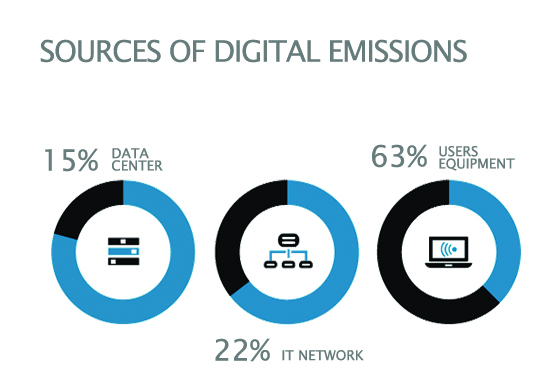
Computers, smartphones, tablets, computer equipment: digital technology is omnipresent in our daily lives and will continue to increase. High time to ask questions about its ecological impact on the environment, and about the way we interact with digital technology.
The Internet today emits as much CO2 as air travel and consumes 16% of the world’s electricity. The annual ecological digital footprint of an employee is equivalent to nearly 360 kg of CO2 annually or about 2,400 kilometers traveled by car 1.
Source: International Energy Agency
In view of these facts, it is legitimate to ask what the Internet and, more generally, digital technology will mean for our environment in the coming years. It is not a question of doing without the progress that the new information and communications technologies bring us. Rather, we need to question their energy-intensive and poorly optimized operation. There is a growing awareness among the population. A new concept is currently emerging that is leading to new consumption models: digital sobriety.
What does digital sobriety mean?
Digital sobriety means learning to reduce one’s ecological digital footprint and thus CO2 emissions in everyday life. This includes changing our digital consumption habits, as well as using products that consume less energy.
Isabelle Autissier, President of WWF France, put it this way:
« We urgently need to set in motion an alternative concept that guarantees the production of organic, fair, local, accessible, ethical, useful and constructive bytes in sufficient quantity starting from their creation, but most importantly, no more than necessary. This concept already exists; it is called digital sobriety».
There are two approaches to digital sobriety: the blue economy and the green economy. The former is aimed at the present, while the latter aims towards the future.
The blue economy
The blue economy concept, conceived by Belgian entrepreneur Gunter Pauli, is based on the principle of a recycling economy and takes this thinking even further.
Known as the “Steve Jobs of sustainable development,” he advocates the idea that all waste produced is to be used as a source of energy for another process. His credo is “nothing is lost, everything is recycled.” According to G. Pauli, the key is simply to “discover the value of waste.”
Returning to the topic of digital consumption: Adopting the concept of the blue economy means that we use our IT products throughout their entire life cycle. It is too late to have an impact on their production when we make a purchase – we already hold the products in our hands. This is why we must try to get as much use out of them as possible by extending their service life and recycling the components that can be recycled.
The green economy
The green economy principle does not question the fact of consumption, but entails consuming more responsibly. Here we try to reduce the impact on our environment with the aim of keeping our “natural capital” in balance. Not consuming more than nature offers us is the driving force behind the green economy concept.
Coming back to digital consumption: adhering to the concept of the green economy means using products that are more environmentally friendly and less energy consuming.
How can a digital-sobriety concept be introduced in companies?
1. Sensitizing employees to a more mindful digital culture
Any change management is initially based on an information and education phase for the stakeholders. It is important to communicate about the topic to raise people’s awareness.
Furthermore, the approach to a more responsible digital world must be in line with the company’s values; it is about leading by example top-down for better cohesion. Behavioral changes affect everyone. The resulting success is then also based both on the individual and collective efforts of employees as professionals and individually.
2. Turning to environmentally compatible products
To be effective, the digital sobriety concept must also be integrated into the company’s IT purchasing policy. As Muriel Barnaud, Director of Social Engagement at La Poste Group, points out, “Purchasing power is also about changing the world. You have to know how to build appropriate clauses into calls for tenders.”
Questioning energy consumption before purchasing equipment is therefore fundamentally important, and the range of more environmentally friendly solutions in the market is visibly growing.
The ROOMZ display consumes 10,000 times less power
ROOMZ did not wait for digital sobriety to take a more environmentally friendly approach. Ecological aspects were already taken into account when it came to the components of our devices. On average, a ROOMZ meeting room display uses 10,000 times less power than a tablet and has a lower ecological impact for several reasons:
Our solutions are 100% wireless. This means that no additional equipment is required, such as for laying cables or installing a PoE switch.
The sustainability of our products is among our guiding principles. Our screens display in black and white and a ROOMZ tablet only connects during an average of two minutes each day, the rest of the time it is in “standby” mode. This subjects the components of our screens to very little stress, guaranteeing a long product life (well over 10 years is possible).
We guarantee our products for two years (with the option extending to five years), while the life of our batteries alone is four years for the screens and five years for the sensors.
ROOMZ products: (eco)logical!
When you choose ROOMZ solutions, you are choosing products that consume little energy and are designed to adapt to the strategic and organizational developments in your company. The year 2021 will continue in this spirit, with increasingly eco-friendly projects that we look forward to soon presenting to you!
You can have a positive impact on the environment by opting for a green solution right at the start of an IT procurement project. As Anne-Cécile Orgerie, IT researcher at IRSA, points out, there is still to a lot to be done in terms of existing equipment:
« Power consumption is already at a maximum when a router operates at 60% of its capacity. This also applies to data centers that are little used at night. They consume a lot of energy even with little activity. »
We can, however, influence developments in the coming years through our decisions.
3. Simple measures at the workplace to reduce ecological impact
Even small changes implemented with the scope of a company’s CSR policy can significantly reduce its employees’ ecological digital footprint.
Limit the sending of e-mails
Worldwide, nearly 12 billion emails are sent every hour, which is equivalent to the electricity produced by 18 nuclear power plants for one hour2 From sending to storage, this means that e-mails exchanged every day consume a considerable amount of energy.
One way to reduce their ecological impact is to reduce the number of recipients as much as possible. It also makes sense to add links instead of attachments in an e-mail. This reduces the weight of messages, making them less harmful to the environment. Finally, you can reduce the number of messages stored on the servers by regularly emptying your trash bin.
Reducing accounts
The greater the number of accounts that are created, the more data is stored on constantly running applications. The data tends to only be replicated from one account to another and therefore does not add any value. Reducing the number of existing accounts is therefore a good practice that we should adopt in both our personal and professional lives.
Careful handling of computer equipment
Even the devices we use every day for work or pleasure are energy hungry. So the following actions are good for our planet: putting the computer in standby mode after a few minutes, turning it off at night, using the “eco” display mode, regularly emptying the “Downloads” tab, and closing tabs or applications that do not need to be open.
Overhauling computer equipment
It is known that a great deal of digital pollution (about 57%) is generated during the production of equipment. Therefore, when renewing a computer park, it is a good idea to contact a dealer who knows how to give your equipment (often still in very good condition) a second life by refurbishing it.
Reducing print-outs
Print only when necessary and preferably double-sided, use recycled paper with a label (FCS or Blue Angel), remove unnecessary elements (e.g. images) and buy recycled ink cartridges. With these few simple measures, you can save up to 90% water.
The shift to an ecological way of doing business and the associated digital transformation represent two major challenges for the 21st century. Understanding of this is on the increase; more and more CSR charters are emerging, such as Planet Tech’Care, which has already been signed by more than 157 international companies.